 English
 中文简体
A 3/4 to hose adapter is a transition fitting that joins a 3/4-inch threaded pipe port to a flexible hose. The 3/4 refers to the thread size, not the hose bore, so the adapter has two separate specifications: the thread end and the hose-tail end. The practical answer is to confirm the thread standard, gender, and barb size before choosing material or price.
If the thread is wrong, the adapter will not seal even when it starts on a few turns. If the barb is wrong, the hose may leak, kink, or pull off under pressure. In plastic piping, the adapter material and pressure rating also need to match the line, because a metal adapter on a plastic port can create a weak point.
What a 3/4 to Hose Adapter Does
A 3/4 to hose adapter converts a threaded pipe connection into a hose-tail connection, and it is specified by both ends, not by one nominal size.
The thread end may be male or female. Common standards are BSPP (G, parallel), BSPT (R, tapered), and NPT (tapered). The hose end is a barb, also called a hose tail or hose nipple. A 3/4 thread can be supplied with a 1/2 in, 3/4 in, or 1 in barb, so the hose bore is a separate choice.
| Thread end | Seal method | Common mismatch | Typical use |
|---|---|---|---|
| BSPP / G parallel | Flat gasket or O-ring | Looks like BSPT but has no taper | Plastic pumps, tanks and manifolds |
| BSPT / R tapered | PTFE tape or paste on threads | Mixed with NPT; 55° versus 60° thread angle | Short pipe joints and equipment connections |
| NPT tapered | PTFE tape or paste on threads | Mixed with BSPT; leaks under pressure | North American equipment and skids |
BSPT and NPT can start to thread together, which is why hand-threading a few turns is not proof of compatibility. A thread gauge or a known sample is the safer check.
Thread Standard and Gender Matter More Than the Hose Size
The most common ordering error is specifying only “3/4 to hose” without stating thread standard and gender.
A male adapter threads into a female port; a female adapter accepts a male nipple. For plastic pipe, a plastic male thread into a metal female port is usually safer than a metal male thread into a plastic female port. If a metal male thread is unavoidable, hand-tighten and use a compatible seal; do not use pipe force to close the gap.
On the pipe side, a PPH male-thread socket fitting is often the starting point when the port is female. The product card below shows a PPH external-thread hot-melt socket fitting; pair it with a compatible hose tail and seal.
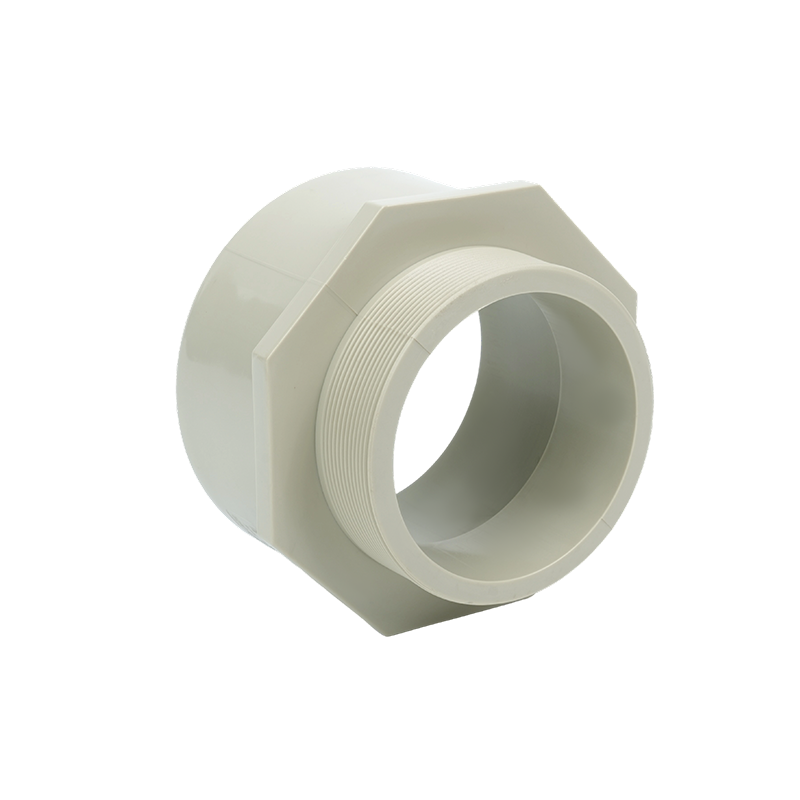 β-PPH External-Thread Hot-Melt Socket Pipe FittingFor connecting to a female port, this β-PPH external-thread hot-melt socket fitting is rated 1.0 MPa and available in DN15–DN100.View Product →
If the pipe port is male, use a female-threaded fitting or a union. The product card below shows a PPH internal-thread hot-melt socket fitting for that side.
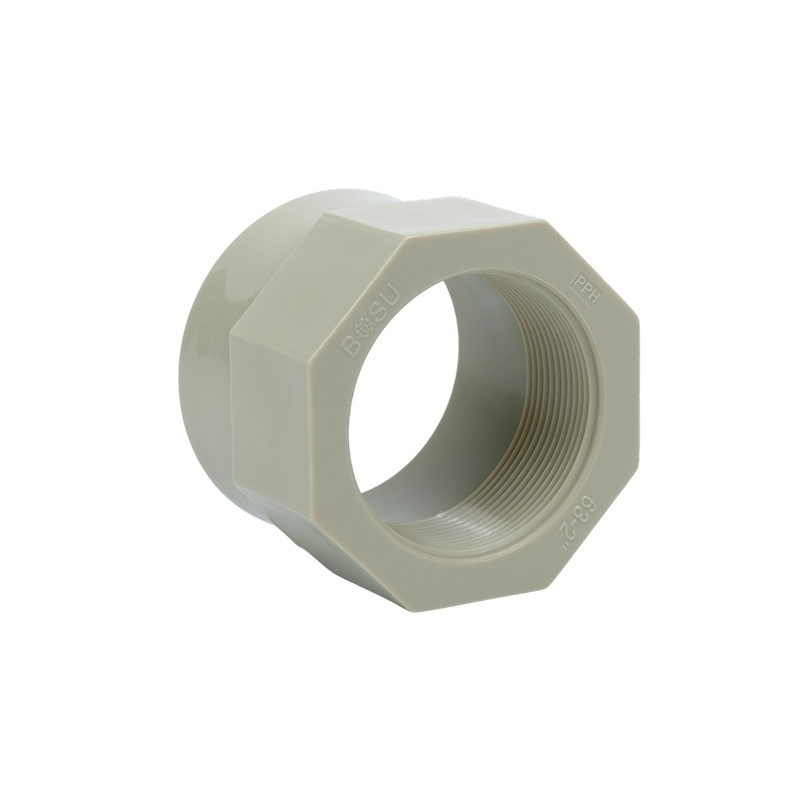 β-PPH Internal-Thread Hot-Melt Socket Pipe FittingFor male pipe ports, this β-PPH internal-thread hot-melt socket fitting is rated 1.0 MPa and offered in DN15–DN100; check thread engagement and sealing method.View Product →
Check thread engagement depth as well. A parallel thread needs a gasket or O-ring to seal, while a tapered thread seals on the threads. Mixing these sealing methods is a common source of leaks.
Material and Pressure Selection for Plastic Piping
Choose the adapter material for the fluid and the pipe material, not only for the thread.
PPH is a common choice for water, many dilute chemicals, and aquaculture lines. PPN is selected where higher pressure or temperature demands it. PVDF is used for aggressive chemicals and high-purity work. Confirm compatibility with the actual concentration and temperature, because a material that suits water may not suit a solvent.
| Material | Typical role in a 3/4 hose adapter assembly | Strength | Watch point |
|---|---|---|---|
| PPH | Pipe-side fitting, hose tail or valve connection | Good chemical resistance for many water and chemical lines | Lower pressure and temperature capability than PVDF; check UV exposure |
| PPN | Higher-pressure plastic piping | Available in higher pressure classes, including 6 MPa pipe ranges | Confirm the adapter rating, not just the pipe rating |
| PVDF | Aggressive chemicals and high-purity lines | Excellent chemical resistance | Higher cost; requires proper welding and support |
| Metal | High-strength hose adapter | Resists mechanical damage | Can damage plastic female threads; check corrosion and galvanic risk |
The adapter is often the lowest-rated part of the assembly because the hose barb, seal, or plastic thread limits pressure. Do not assume that a 1.6 MPa pipe makes the complete 3/4 hose adapter assembly a 1.6 MPa connection.
Sizing, Flow and Installation Checks
Size the thread, barb, and hose together, then install with the correct seal and support.
- Identify the thread. Measure the outside diameter and pitch, or use a BSPP, BSPT, and NPT gauge. Do not rely on the thread count alone.
- Check gender and port depth. Confirm male or female and make sure the adapter does not bottom out before the seal engages.
- Match the hose. Measure the hose ID. A 3/4 thread does not mean a 3/4 hose; the barb size controls the hose fit.
- Select the seal. Use a flat gasket or O-ring for parallel threads. Use PTFE tape or paste on tapered threads, leaving the first thread clear.
- Support the hose. Fit a clamp within a short distance of the adapter and avoid hanging the hose load on the thread.
- Pressure test. Test with water where possible before putting the line into service.
Flow resistance also matters. An undersized barb adds pressure loss, and the relationship between pipe diameter, flow velocity, and pressure is covered in this article on pipe diameter, flow velocity, and pressure.
Common Buying Mistakes
Most 3/4 to hose adapter failures come from specification errors, not from the plastic itself.
- Treating 3/4 as the hose size instead of the thread size.
- Mixing BSPT and NPT because both start to thread.
- Using PTFE tape on a parallel gasket port.
- Over-tightening a metal male thread into a plastic female port.
- Assuming the adapter shares the pipe’s pressure rating.
- Leaving the hose unsupported or unclamped.
- Choosing the wrong seal material for the chemical.
FAQ
The answers below cover the specification points that most often cause a return or a leak.
Is a 3/4 to hose adapter the same as a 3/4 NPT adapter?
No. 3/4 describes a nominal thread size, while NPT is one thread standard. The adapter could be BSPP, BSPT, or NPT, so confirm the standard before ordering.
What hose size fits a 3/4 to hose adapter?
It depends on the barb. A 3/4 thread may carry a 1/2 in, 3/4 in, or 1 in hose tail; measure the hose ID and the barb OD, not just the thread.
Can I use PTFE tape on a plastic hose adapter?
Yes for tapered threads, but not for parallel threads that seal on a gasket or O-ring. Tape on a gasket face can prevent sealing.
Can I connect a metal hose adapter to a plastic pipe port?
Yes, but avoid a metal male thread into a plastic female port where possible. Use a plastic male thread into a metal female port, or a reinforced port, and do not over-tighten.
What pressure rating should I choose?
Match the adapter to the system pressure and verify the complete assembly, including the hose and clamp. If the adapter rating is lower than the pipe rating, the adapter sets the limit.
Getting the Right Fit
The right 3/4 to hose adapter is the one that matches the thread standard, gender, hose barb, material, and pressure rating of the actual line.
For plastic piping projects in water treatment, chemical handling, aquaculture, or manufacturing, confirm the pipe-side connection first, then select the hose tail and seal. If you need help matching a PPH, PPN, or PVDF fitting to a 3/4 in port, contact our team with the thread photo, hose ID, media, and pressure.