Content
In industrial piping systems, the Auxiliary Material Series are not optional accessories but core components that ensure system sealing integrity, stability, and long-term reliability. From flange gaskets and flexible connectors to pipe clamps, nozzles, and mechanical fittings, these auxiliary materials directly impact the pipeline's pressure-bearing capacity, media compatibility, and maintenance cycles. According to engineering practice data, approximately 80% of pipeline leakage incidents originate from improper auxiliary material selection or incorrect installation, rather than defects in the main piping material itself. Therefore, scientifically configuring the Auxiliary Material Series is the primary step in ensuring safe operation of industrial piping systems in chemical processing, water treatment, pharmaceutical manufacturing, and related applications.
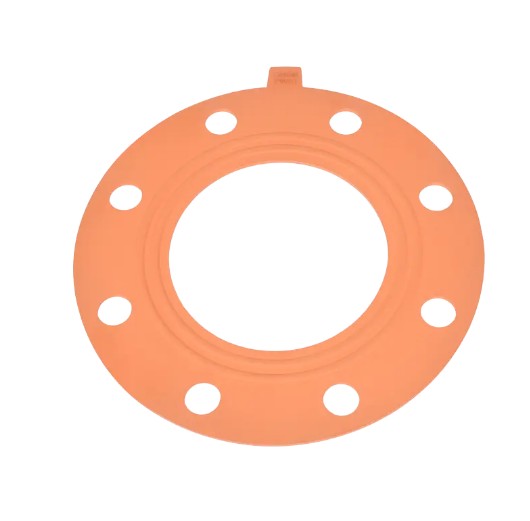
Flange gaskets are critical sealing elements at pipeline joints that prevent media leakage. Depending on material composition and operating conditions, common flange gasket types include EPDM (Ethylene Propylene Diene Monomer), FPM (Fluorocarbon Rubber), and EPDM+PTFE composite gaskets, each suited for different temperature ranges and chemical environments.
| Material Type | Temperature Range | Chemical Resistance | Applicable Conditions |
|---|---|---|---|
| EPDM | -55°C ~ +150°C | Water, acid & alkali resistant; not mineral oil resistant | Water treatment, cooling systems |
| FPM (Viton) | -20°C ~ +250°C | Oil and strong corrosive media resistant | Chemical, petroleum, high-temperature applications |
| EPDM+PTFE | -200°C ~ +260°C | Resistant to virtually all chemicals | Highly corrosive, high-purity media |
The flange gasket specification system follows nominal diameter (DN) standards, with common specifications including DN15 (D20), DN20 (D25), DN25 (D32), DN32 (D40), covering multiple applications from low to high pressure. Selection should focus on the following three dimensions:
Between pump equipment and piping systems, flexible connectors serve the critical function of absorbing mechanical vibration and compensating for thermal expansion and contraction. PPH (Polypropylene Homopolymer) flanged flexible connectors, with their excellent chemical resistance, have become standard configurations for chemical piping systems.
Concentric flanged flexible connectors are suitable for straight-line connections of identical pipe diameters, effectively absorbing axial displacement of 10-15mm. Eccentric reducer flanged flexible connectors, on the other hand, are used for transitions between different pipe diameters, with common specifications such as D40×32, D50×32, D50×40, D63×32, D63×40, maintaining flexible buffering functionality while achieving diameter transitions.
Pipe clamps are indispensable fixing elements in pipeline installation, serving to constrain pipeline displacement, evenly distribute support forces, and prevent pipeline sway caused by fluid impact. PPH pipe clamps share the same chemical resistance as the piping body itself, avoiding the electrochemical corrosion issues commonly seen with metal clamps.
The pipe clamp series covers the full diameter range from DN15 (D20) to DN50 (D63), featuring snap-on or bolt-tightening structures. Taking the DN32 pipe clamp as an example, its standard load-bearing capacity is no less than 500N, capable of withstanding dynamic impact forces generated when internal fluid flow velocity reaches 4.5m/s. In multi-layer pipeline parallel installation scenarios, a layered arrangement strategy is recommended, with interlayer spacing maintained at ≥150mm to facilitate maintenance operations.
Pull handles and hinge series fittings are primarily used for opening mechanisms on equipment enclosures and inspection port covers. Heavy-duty hinges, made from glass-fiber-reinforced PP, offer single-unit load-bearing capacity of 80-120kg, suitable for frequently opened/closed applications such as large filtration equipment and reactor manholes. Small hinges are suitable for light-load scenarios like instrument boxes and control cabinets, with standard mounting hole spacing of 25mm×40mm, compatible with standard sheet metal cutout dimensions.
Spiral nozzles transform liquid into hollow-cone or solid-cone sprays through a unique spiral flow guide structure, widely used in gas scrubbing, cooling, fire protection sprinkler systems, and chemical reaction towers. Their most notable characteristic is exceptional anti-clogging capability, with flow passage diameters up to 3 times the nozzle outlet diameter, making them suitable for circulating water systems containing suspended particles.
| Nominal Diameter | Connection Size | Spray Angle | Typical Flow Rate (0.7MPa) |
|---|---|---|---|
| DN15 (D20) | 1/2" BSPT | 60°-120° | 15-30 L/min |
| DN20 (D25) | 3/4" BSPT | 60°-170° | 30-80 L/min |
| DN25 (D32) | 1" BSPT | 90°-180° | 80-150 L/min |
| DN32 (D40) | 1-1/4" BSPT | 120°-180° | 150-250 L/min |
| DN40 (D50) | 1-1/2" BSPT | 120°-180° | 250-400 L/min |
| DN50 (D63) | 2" BSPT | 120°-180° | 400-600 L/min |
Spiral nozzle bodies are typically made from PPH or glass-fiber-reinforced polypropylene, with ceramic or 316L stainless steel inserts for the nozzle core. In flue gas desulfurization (FGD) systems, where slurry solid content reaches 15%-20%, full-flow non-reduced-diameter spiral nozzles must be selected, ensuring minimum passage diameter ≥15mm. In semiconductor ultrapure water systems, PTFE nozzles are required to ensure extractable ions content remains below 0.1ppb.
Colored pipe fittings use different colors to distinguish media types or process flows, serving as an effective means to improve piping system management efficiency. In large industrial installations, standardized color coding can shorten maintenance response times by 30%-40% and significantly reduce misoperation risks.
The base material of colored fittings remains standard PPH, with colors incorporated into the surface layer through co-extrusion or injection molding processes, typically at a thickness of 0.5-1.0mm, without affecting the fitting's body strength or chemical resistance. It should be noted that in areas with strong outdoor UV exposure, UV-stabilized color masterbatch should be selected to prevent color fading that could compromise identification effectiveness.
The selection of Auxiliary Material Series should not be conducted in isolation but designed in coordination with the main piping system. The following are proven selection strategies from engineering practice:
When comparing auxiliary material solutions, attention should not be limited to initial procurement costs alone; total life cycle cost (LCC) should be calculated. Taking DN50 chemical pipelines as an example, although the initial cost of EPDM+PTFE composite gaskets is approximately 40% higher than standard EPDM gaskets, in highly corrosive operating conditions, their replacement cycle extends from 6 months to over 3 years, reducing comprehensive maintenance costs by more than 60%.
Establishing a media-material compatibility matrix is a critical step in avoiding selection errors. For example, when conveying chlorine-containing bleach (sodium hypochlorite concentration >10%), EPDM gaskets undergo rapid aging and cracking, requiring PTFE or FPM materials instead. In hot water systems above 80°C, FPM's compression set rate (<15%) is significantly superior to EPDM (>25%), ensuring long-term sealing reliability.
It is recommended to standardize auxiliary material specifications to four base diameters—DN15, DN25, DN50, DN100—covering over 80% of application scenarios. By reducing specification variety, spare parts inventory costs can be lowered by 35%-50%, while shortening material mobilization time during emergency repairs. For non-standard requirements under special operating conditions, it is advisable to reserve a 10%-15% customization ratio to ensure flexibility in system design.

Products
Company Information
Address: No. 55 Haichuan Road, High-Tech Zone, Dongtai City, Jiangsu Province, China
Mobile: +86 137 7009 5258
Tel: +86-515-85479999
Email: [email protected]
We'd love to hear from you!

 English
 中文简体
中文简体